
Choosing the right Custom Made Cabinets supplier in 2026 requires more than comparing glossy catalogues. Global buyers need dependable construction, clear communication, and evidence of production quality. A beautiful door sample cannot reveal weak hinges, uneven joints, or delayed shipping.
Tom Silva, veteran carpenter and This Old House expert, offers a practical standard: “Good cabinetry begins with accurate measurements, not attractive pictures.” That principle matters when suppliers serve homes, hotels, offices, and developers across different regions. Accurate drawings should show cabinet dimensions, material thickness, hardware positions, finishes, and installation requirements. Buyers should also request full-size samples. A painted panel under showroom lighting may look different beside a window or under warm LEDs.
This guide examines the 2026 top Custom Made Cabinets suppliers for global buyers. It considers manufacturing experience, design flexibility, quality control, export support, packaging, lead times, and after-sales service. Strong suppliers usually provide factory photographs, material specifications, inspection procedures, and references from completed international projects. Their quotations should separate cabinet costs, hardware, packaging, freight, taxes, and installation support.
Details matter greatly.
However, no supplier ranking is flawless. A factory may deliver excellent kitchens yet struggle with complex commercial orders. Another may offer competitive prices but communicate slowly across time zones. Buyers should verify claims independently, confirm tolerances in writing, and test a sample order before committing to a large project. Sustainability also deserves attention, including responsible timber sourcing, low-emission finishes, durable components, and reduced packaging waste. The best choice is rarely the cheapest quote. It is the supplier that turns precise requirements into consistent, installable, and lasting cabinetry.
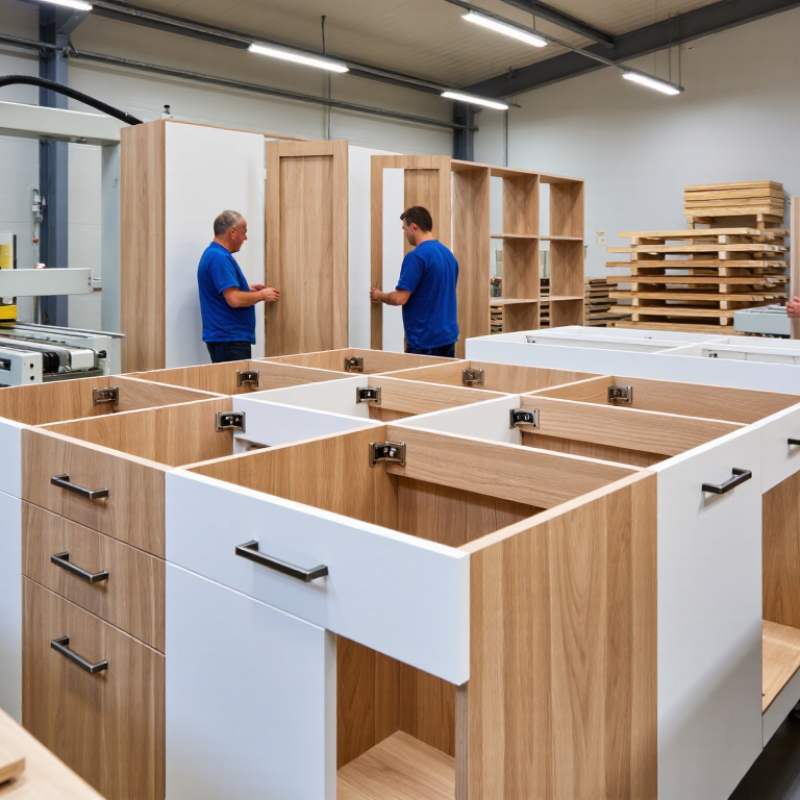
Custom made cabinets are built to fit a specific room, rather than standard factory dimensions. Buyers can choose the cabinet width, depth, wood species, finish, hardware, and internal storage. This matters in homes with uneven walls, narrow corners, tall ceilings, or unusual plumbing locations.
Global buyers often choose custom cabinetry for better space use and longer service life. The 2024 U.S. Houzz & Home Study reported a median spend of $60,000 for major kitchen renovations. That figure shows how seriously homeowners treat kitchen performance and storage. Custom cabinets can also support regional preferences, such as deep drawers in North America or compact vertical storage in smaller European kitchens. However, custom does not automatically mean perfect. Poor measurements, unclear drawings, and weak moisture protection can still create expensive problems.
Tips: Request a detailed shop drawing before production. Confirm panel thickness, edge treatment, hardware load ratings, finish samples, packaging, and delivery terms. The Kitchen Cabinet Manufacturers Association emphasizes performance testing for durability and finish quality. Buyers should also verify material certifications and ask how replacement parts are handled. A low quote may hide weaker boards or limited after-sales support. In practice, careful documentation often matters as much as attractive design.
| Supplier Capability Category | Typical Cabinet Construction | Common Materials and Finishes | Customization Scope | Indicative MOQ | Indicative Production Lead Time | Typical Buyer Applications | Key Global-Buyer Advantages | Important Verification Points |
|---|---|---|---|---|---|---|---|---|
| Flat-Pack Kitchen Cabinet Supplier | Ready-to-assemble panels with cam-locks, dowels, screws, or confirmat fasteners | MDF Particleboard Melamine Thermofoil | Door styles, cabinet widths, colors, storage accessories, handles, hinges, and drawer systems | Commonly project-based or pallet-based; supplier-specific | Often about 4–10 weeks after approved drawings and deposit | Residential kitchens, apartments, renovation programs, and online furniture distribution | Lower shipping volume, easier warehouse handling, and simplified installation | Confirm panel thickness, edge-banding quality, hardware load ratings, assembly instructions, and carton drop-test procedures |
| Fully Assembled Cabinet Supplier | Factory-assembled carcases with doors, drawers, and hardware installed before shipment | Plywood MDF Solid Wood Painted Finish | Custom dimensions, decorative end panels, crown moldings, toe kicks, drawer layouts, and finish matching | Usually higher than flat-pack orders because of labor and packing requirements | Often about 6–12 weeks after final approval | High-end residential projects, hospitality interiors, and design-led developments | Reduced installation work and consistent factory alignment | Check packaging protection, container utilization, door and drawer adjustment, moisture control, and damage-claim procedures |
| Solid-Wood Custom Cabinet Supplier | Frame-and-panel or frameless construction using solid wood components with engineered panels where appropriate | Oak Maple Walnut Ash | Wood species, grain direction, stain color, glazing, profiles, bead details, and bespoke dimensions | Often quotation-based because material selection and craftsmanship vary substantially | Often about 8–16 weeks for custom projects | Luxury residences, heritage renovations, boutique hospitality, and premium interiors | Distinct natural appearance, repairability, and strong design differentiation | Verify moisture content, wood grading, finish samples, color variation policy, legal timber documentation, and sustainability claims |
| Plywood Cabinet Supplier | Carcases and shelves made primarily from layered wood veneer panels bonded into plywood | Birch Plywood Hardwood Plywood Veneer HPL | Panel thickness, exposed edges, veneer species, laminate surfaces, cut-outs, and hardware configuration | Usually available for project or batch purchasing; supplier-specific | Often about 5–12 weeks after technical approval | Kitchens, bathrooms, retail interiors, offices, and humid-climate projects | Good screw-holding performance and dimensional stability compared with many lower-grade board options | Confirm plywood grade, number of plies, formaldehyde emissions, core voids, veneer quality, and water-resistance claims |
| Commercial and Hospitality Cabinet Supplier | Project-based casework designed for repeated use, coordinated installation, and site scheduling | HPL Melamine Plywood Compact Laminate | Room-by-room schedules, fire-rated options where required, service panels, bulkheads, vanities, bars, and reception units | Typically tied to a complete project or repeat development program | Commonly 8–20 weeks, including shop drawings and sample approvals | Hotels, student housing, offices, restaurants, healthcare, and multi-unit housing | Coordinated documentation, repeatable specifications, and installation planning for large projects | Check shop-drawing standards, fire and hygiene requirements, mock-up approvals, site tolerances, and phased-delivery capacity |
| Bathroom Vanity and Moisture-Resistant Cabinet Supplier | Sealed or edge-protected cabinet boxes designed for exposure to splashes and elevated humidity | Marine-Grade Plywood PVC Board HPL Powder-Coated Metal | Vanity widths, sink cut-outs, plumbing clearances, drawer layouts, mirror cabinets, and integrated lighting provisions | Commonly batch-based or project-based | Often about 5–12 weeks after sink and plumbing details are confirmed | Residential bathrooms, hotels, serviced apartments, and healthcare facilities | Efficient adaptation to local plumbing layouts and compact room dimensions | Verify sealing methods, substrate performance, hardware corrosion resistance, drainage clearances, and cleaning-chemical compatibility |
| Sustainable and Low-Emission Cabinet Supplier | Standard cabinet construction using certified or recycled materials and lower-emission adhesives or coatings | FSC-Certified Wood Recycled Board Water-Based Coating Low-Emission Panels | Material substitutions, environmental product documentation, recycled content, take-back planning, and finish selection | Varies according to certified-material availability and production volume | Often about 6–14 weeks because certification and material approval may add time | Green building projects, public procurement, offices, and environmentally focused housing | Supports responsible sourcing objectives and indoor-air-quality requirements | Request current certificates, chain-of-custody information, emissions test reports, recycled-content evidence, and scope of each claim |
| Design-to-Order Cabinet Supplier | Parametric or engineer-to-order production based on buyer drawings, room dimensions, and approved samples | Mixed Materials Veneer Laminate Painted MDF | Full control over dimensions, storage layouts, door profiles, materials, colors, accessories, and installation interfaces | Usually quotation-based; small prototypes may be possible before bulk production | Often about 8–18 weeks, including design engineering and sample approval | Architectural interiors, unusual room layouts, export housing programs, and premium renovations | Maximum design flexibility and better adaptation to local building conditions | Confirm CAD formats, revision control, tolerance schedules, sample approval process, intellectual-property ownership, and change-order costs |



© 2025 Acadia Craft. Powered by Integrity Marketing Serving Woodinville, Kirkland, Bellevue & The Greater Seattle Area